
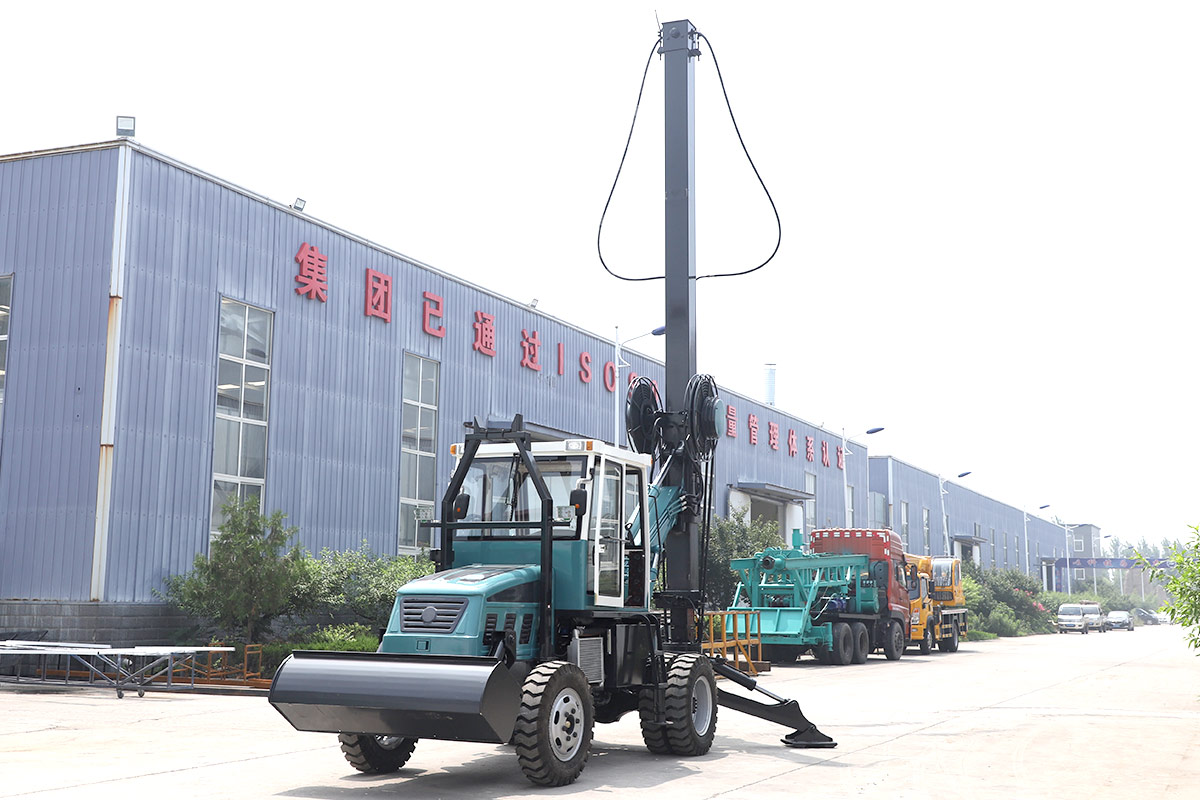
Rotary excavator, also known as rotary drilling rig and pile driver, is a comprehensive drilling rig. It can use a variety of bottom layers and has the characteristics of fast hole forming speed, less pollution, and strong mobility. The short auger bit is used for dry excavation, and the rotary bit can also be used for wet excavation in the case of mud retaining walls. The rotary excavator can cooperate with the hammer to drill through the hard formation and then carry out the digging operation. If it is matched with the expansion head drill, the hole reaming operation can be carried out at the bottom of the hole. The rotary excavator adopts multi-layer telescopic drill pipe, which has less auxiliary drilling time, low labor intensity, no need for mud circulation and slag discharge, which saves costs and is especially suitable for the foundation construction of urban construction.
1. Main performance characteristics of rotary excavator
1. Strong maneuverability and quick transition.
2. There are various types of drilling tools, which are lightweight and can be quickly loaded and unloaded.
3. Adapt to a variety of formations, and the speed is fast, about 80% faster than the impact drill.
4. Little pollution to the environment, no need to recycle slag.
5. It can correspond to various types of piles.
2. How to choose the drill bit of the rotary excavator
The selection of the drill bit of the rotary excavator is mainly determined according to the following three aspects: formation conditions; drilling rig function; hole depth, diameter, ballast thickness, wall protection measures, etc. Common rotary drilling bits include auger bits, rotary drilling buckets, barrel core bits, bottom-reaming bits, impact bits, punching and grabbing cone bits and hydraulic grabbing buckets.
Since the formation conditions are ever-changing, the objects of the rotary drilling rig are particularly complex. The corresponding drill bits should be selected according to different geological conditions, mainly in the following categories:
1. Clay: use the commonly used straight-tooth cone bucket drill bucket, the drilling speed is fast, and the soil unloading is easy and convenient;
2. Sludge, weak cohesive soil layer, sandy soil, pebble layer with poor cementation and small particle size: it can be equipped with a drill bucket with double bottom and spiral teeth;
3. Hard cement: choose a rotary drill bucket with a single soil inlet (single and double bottoms), or a bucket tooth straight screw;
4. Frozen soil layer: straight auger buckets and rotary drilling buckets with low ice content can be used, and conical auger bits can be used with large ice content. It should be noted that the auger bit is effective for soil layers (except for silt), but it must be used when there is no groundwater and the stratum is stable, so as to avoid suction and cause stuck;
5. Cemented pebbles and strongly weathered rocks: need to be equipped with conical auger bit and double bottom rotary drilling bucket (single port for larger particle size, double port for small particle size), equipped with alloy bucket teeth (Bullet) is better;
6. Medium-weathered bedrock: according to the sequence of the process, it can be equipped with a pick barrel type coring bit → a conical auger bit → a double-bottom rotary drilling bucket; or a straight auger bit with a pick → a double-bottom rotary drilling bucket;
7. Micro-weathered bedrock: According to the sequence of the process, the cone-type coring bit → the conical auger bit → the double-bottom rotary drilling bucket are used in sequence. If the diameter is too large, a graded drilling process is also adopted.
Of course, the selection of rotary excavator drill bits is not only determined according to the geological conditions, but also needs to be specifically combined with the construction requirements of the construction environment to determine the choice of drill bits. During the drilling process, also pay attention to the verticality of the drill mast to avoid tilting the drilling.
Related News
-
What is the use of photovoltaic pile driver? What kind of environment is suitable
It was originally designed as a pre-piling equipment for photovoltaic power plants. Through research and development and upgrading, it can also be used in piling projects such as farms, pastures, and orchards. -
What are the characteristics and advantages of photovoltaic pile drivers?
The machine was originally developed for building solar power plants, but it can also be used in other areas, such as building new roads by securing road safety barriers by piling. -
Features and uses of photovoltaic pile drivers
Introduction to the characteristics and uses of photovoltaic pile drivers. When it comes to photovoltaic pile drivers, you may not know much about them. Below I will give you a brief introduction to photovoltaic pile drivers and the populari -
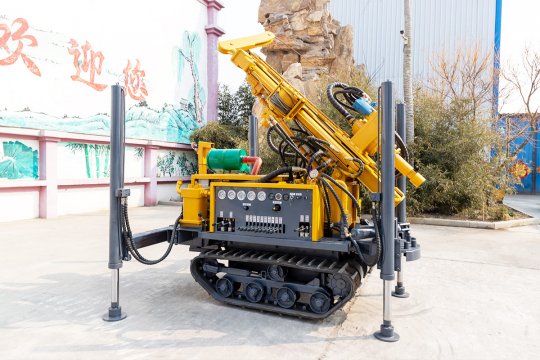
What are the characteristics of pneumatic drilling rigs? What are the advantages?
Pneumatic well drilling equipment, strong horsepower, fast drilling and fast water output. -
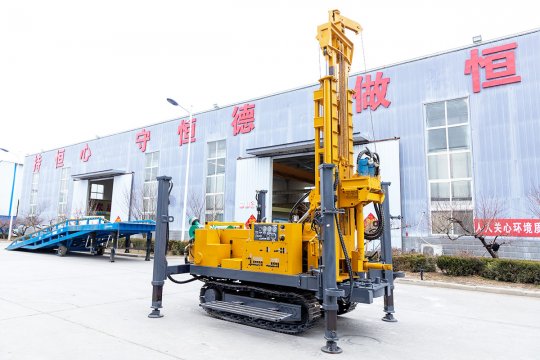
What are the characteristics and functions of air drills?
It is widely used in drilling water wells, detection wells, precipitation wells, rescue wells, ground source air conditioning holes, coal bed methane, natural gas, oil exploration and other projects.